Uvita Whale Watching Season
Understand Uvita’s two humpback migration periods, the uncertain edge months and the difference between whale season and snorkelling conditions.
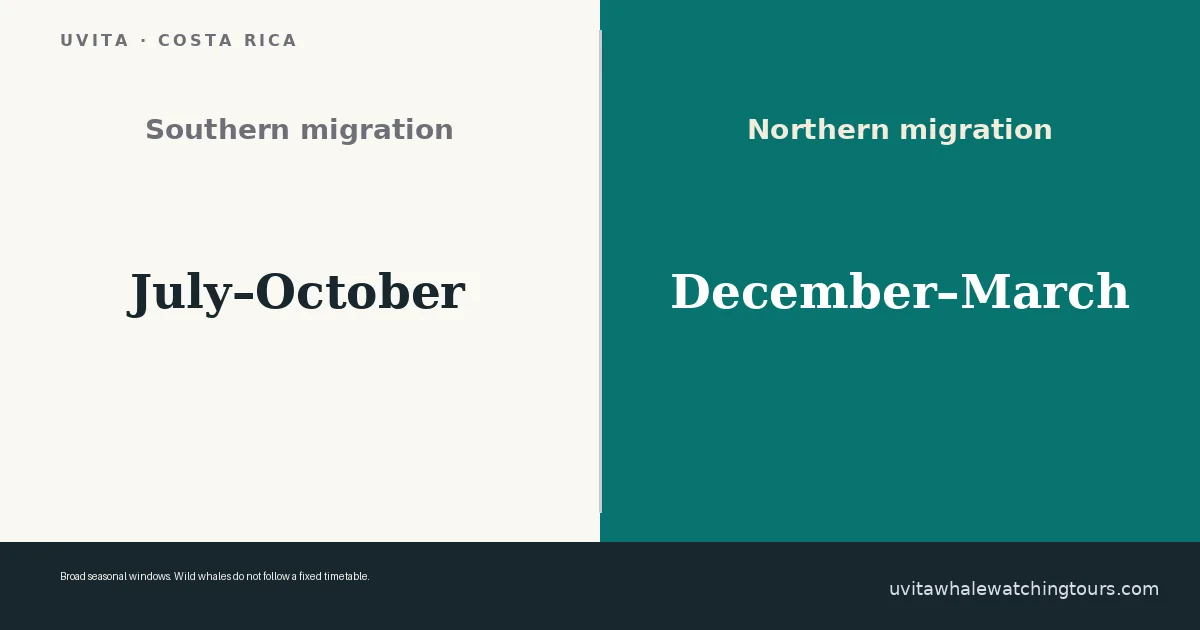
Plan a Uvita whale-watching trip around the humpback migration periods, broadly July–October and December–March, then check recent local conditions for your exact dates. The Dolphin Tour Uvita boat trip runs a coastal wildlife search; a booking does not guarantee a whale encounter, even during a recognised season.
Uvita: Whale & Dolphin Watching Boat Trip w/ Drinks & Snacks
An easy starting point for a first Uvita boat trip: park entry, refreshments and a guided wildlife search in one booking.
Two migration periods, with flexible edges
Costa Rica’s tourism board describes the main whale-watching periods as late July to early November and late December to early April. SINAC’s park information uses whole months: July–November for whales arriving from the south and December–April for those from the north. Our humpback guide explains which humpbacks use each season. The difference is a useful warning against drawing a hard line on a calendar. Animal movements can overlap the typical tourism windows.
For a trip mainly about humpbacks, use the central parts of those windows as your starting point and ask operators about recent activity. If your dates are already fixed, decide whether you would still value dolphins, turtles, seabirds and the coastline if whales remain out of view. Do not let a seasonal percentage in a sales description become a personal guarantee.
A month-by-month planning view
| Months | Planning approach |
|---|---|
| January–February | Within the commonly described northern migration period; check local sightings |
| March | Still within the tourism board’s window, with variable wildlife activity |
| April | An outer edge in SINAC’s broader window; ask locally before planning around whales |
| May–June | Outside the main published humpback windows; consider the whole coastal wildlife experience |
| July | Southern migration period begins broadly around this time; arrival is not a fixed date |
| August–September | Inside the southern period and highlighted by several checked operators |
| October | Still within the main southern window; sea conditions matter for any particular departure |
| November | An edge month: the tourism board’s window closes in early November, and SINAC’s runs to the end of the month |
| December | Northern season starts broadly; early and late month need not be equivalent (winter trip guide) |
This table describes planning windows, not a forecast or a claim that boats cannot see whales outside them. It should help you ask more useful questions when checking available departures.
Whale season is not a snorkelling forecast
Marine visibility depends on water and weather conditions. The featured tour explicitly makes snorkelling conditional and excludes the equipment. Ballena Infocenter’s outing describes snorkelling mainly as a dry-season extra, roughly late December–April, subject to the guide’s decision. Marino Ballena Tours and Info excludes it outright and focuses on wildlife with a swim.
That means a successful whale-watching day can have poor underwater visibility. Choose the reservation for its main purpose. If you want two planned snorkelling sessions with equipment included, compare the separate Caño Island snorkelling day instead of assuming a coastal wildlife boat provides the same activity.
What to ask for your actual dates
Ask whether boats have recently encountered humpbacks, which departures are running and how the operator handles conditions that prevent departure. Also ask about the meeting time and likely time afloat. A report from yesterday can inform the choice, but animals and sea conditions can change before tomorrow’s trip.
Leave room in your itinerary when possible. Avoid placing a non-flexible onward reservation immediately after an ocean outing. The reason is practical: boarding, conditions and the day’s route can affect timings. Use your booking’s exact cancellation and rescheduling terms; policies are not interchangeable between operators.
Dolphins and the rest of the coast
SINAC describes resident dolphins throughout the year. That makes dolphin watching relevant beyond the main humpback periods, but year-round presence does not guarantee a sighting on one departure. Our dolphin-watching guide covers the species and where else to see them in Costa Rica. Seabirds, sea turtles and the coastal formations add interest, with the actual route and encounters shaped by the day.
Read which Uvita tour to choose for practical differences between the boats. Tour format is a choice you can control; the animal encounter is not.
Frequently asked questions
Can I see whales in November or April?
Possibly. SINAC includes these in its broader migration windows, while the tourism board gives narrower core periods. Treat them as uncertain edge months and ask a local operator about recent activity.
Is September a guaranteed whale month?
No. September falls within the southern migration period, but a single departure can still have limited or no whale encounters. Choose it for the seasonal opportunity, without expecting a particular behaviour such as breaching.
Which month is best if I can choose my dates?
For the most whales, plan around September, which sits in the middle of the southern migration but is also one of the wettest months. For month-by-month detail, see Uvita whale watching August to October. For whales with drier weather, January and February are the usual choice. Our month-by-month Costa Rica whale-watching guide sets the two against each other, and it also covers the edge months in more detail than this page does.
Is low tide the best time to see whales?
Low tide matters for walking onto the Whale’s Tail formation. It is a separate planning issue from the seasonal offshore whale search. Check the Whale’s Tail tide times if you want to combine your boat tour with that walk.
Sources checked 8 October 2026: SINAC park information, Costa Rica tourism board and the linked tour listings.
Make Time for the Pacific
Choose your date, check the meeting point and leave room for an ocean adventure. Whales are seasonal; every wildlife encounter is different.
Check Dates & Prices